MOST INFORMATION PROVIDED IS TAKEN FROM :
NERVS AND HORMONES:
The nervous system allows the body to respond to changes in the environment in a process usually coordinated by the brain. Reflex actions are extra-rapid responses to stimuli; this process also involves the nervous system but bypasses the brain.
Receptors
Receptors are groups of specialised cells that can detect changes in the environment called stimuli. Receptors are often located in the sense organs, such as the ear, eye and skin. Each organ has receptors sensitive to particular kinds of stimulus. Anything your body is sensitive to, including changes that you detect in your surroundings are called stimulus.
Cells
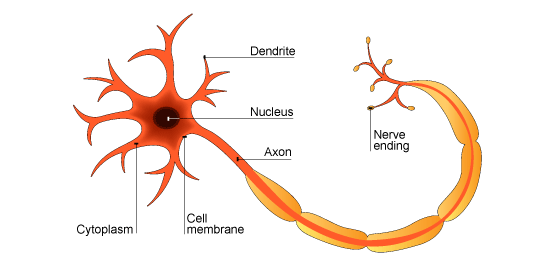
Most animal cells have a nucleus, cytoplasm and cell membrane. Light receptors have these cell components too.
The human central nervous system (CNS) consists of the brain and spinal cord. When a receptor is stimulated it sends a signal along the nerve cells, also called neurones, to the brain. The brain then coordinates the response.
Neurones
Neurones are nerve cells that carry information as tiny electrical signals. There are three different types of neurones, each with a slightly different function:
- sensory neurones carry signals from receptors to the spinal cord and brain
- relay neurones carry messages from one part of the CNS to another
- motor neurones carry signals from the CNS to effectors.
This diagram shows a typical neurone (a motor neurone), which has tiny branches at each end and a long fibre that carries the signals.
Synapses
Where two neurones meet there is a tiny gap called a synapse. Signals cross this gap using chemicals. One neurone releases the chemical into the gap. The chemical diffuses across the gap and makes the next neurone transmit an electrical signal.
Reflex actions
When a receptor is stimulated it sends a signal to the central nervous system, where the brain coordinates the response, but sometimes a very quick response is needed, one that does not involve the brain: this is a reflex action.
Sequence
In a simple reflex action:
stimulus → receptor → sensory neurone → relay neurone → motor neurone → effector
An effector is any part of the body that produces the response. Here are some examples of effectors:
- a muscle contracting
- a gland releasing (secreting) a hormone or other chemical.
Reflex actions are rapid and happen without us thinking. For example, you would pull your hand away from a hot flame without thinking about it. This animation allows you to step through each stage of the reflex arc.
This is what happens:
- receptor detects a stimulus - a change in the environment
- sensory neurone sends impulses to relay neurone
- motor neurone sends impulses to effector
- effector produces a response.
Drugs are substances that change chemical reactions in the body. Medical drugs relieve disease and illness, and are extensively tested before being used. Recreational drugs such as alcohol and tobacco are taken by people because they like the effects they have on their bodies, but they may be addictive. Cannabis and heroin are illegal recreational drugs that are very addictive.
Developing new drugs
New medical drugs have to be tested to ensure that they work, and are safe, before they can be prescribed. There are three main stages of testing:
- The drugs are tested using computer models and human cells grown in the laboratory. Many substances fail this test because they damage cells or do not seem to work.
- Drugs that pass the first stage are tested on animals. In the UK, new medicines have to undergo these tests, but it is illegal to test cosmetics and tobacco products on animals. A typical test involves giving a known amount of the substance to the animals, then monitoring them carefully for any side-effects.
- Drugs that have passed animal tests are used in clinical trials. They are tested on healthy volunteers to check they are safe. Very low doses of the drug are given to begin with. If there are no problems, further clinical trials are done to find the optimum dose for the drug.
Sensitivity in plants
Plants need light and water for photosynthesis. Plant responses - called tropisms - help make sure that any growth is towards sources of light and water.
There are two main types of tropism:
- positive tropism – the plant grows towards the stimulus
- negative tropism – the plant grows away from the stimulus.
Phototropism is a tropism where light is the stimulus. A gravitropism (also called a 'geotropism') is a tropism where gravity is the stimulus. The roots and shoots of a plant respond differently to the same stimuli.
The tropisms of shoots mean that the shoots are likely to grow into the air, where there is light for photosynthesis.
The tropisms of roots mean that the roots are likely to grow into the soil, where there is moisture.

Auxins
Auxins are a family of hormones found in plants. Auxins are mostly made in the tips of the shoots and roots, and can diffuse to other parts of the shoots or roots. They change the rate of elongation in plant cells, controlling how long they become. Shoots and roots respond differently to high concentrations of auxins:
- cells in shoots grow more
- cells in roots grow less.
Phototropisms
In a shoot, the shaded side contains more auxin. This means that the shaded side grows longer, causing the shoot to bend towards the light.
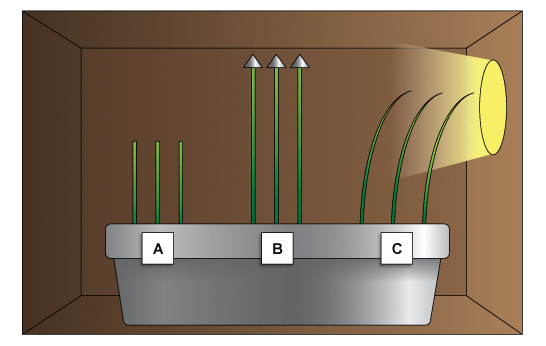
Results and explanations: A)The tips have been removed. No auxin is produced and the shoots do not grow longer. B)The tips have been covered so light cannot reach them. Auxin is in the same concentration on both sides of the shoots, so they grow evenly and longer on both sides. C) One side of the tips are in more light than the other side. Auxin is in a greater concentration on the shaded side, causing the cells there to grow longer than the cells on the lit side.
Auxins have the opposite effect on root cells. In a root, the shaded side contains more auxin, but this time the shaded side grows less than the lit side. This causes the root to bend away from the light.
Gravitropisms
Auxins are also involved in gravitropisms. In a root placed horizontally, the bottom side contains more auxin than the top side. This makes the bottom side grow less than the top side, causing the root to bend in the direction of the force of gravity.
In a shoot placed horizontally, the bottom side contains more auxin than the top side. This makes the bottom side grow more than the top side, causing the shoot to bend and grow against the force of gravity.
QUESTION:
White blood cells can attack pathogens by consuming them or producing antibodies. How else can they attack pathogens?
ANSWER:
They can produce antitoxins, which counteract the toxins produced by the pathogens.
